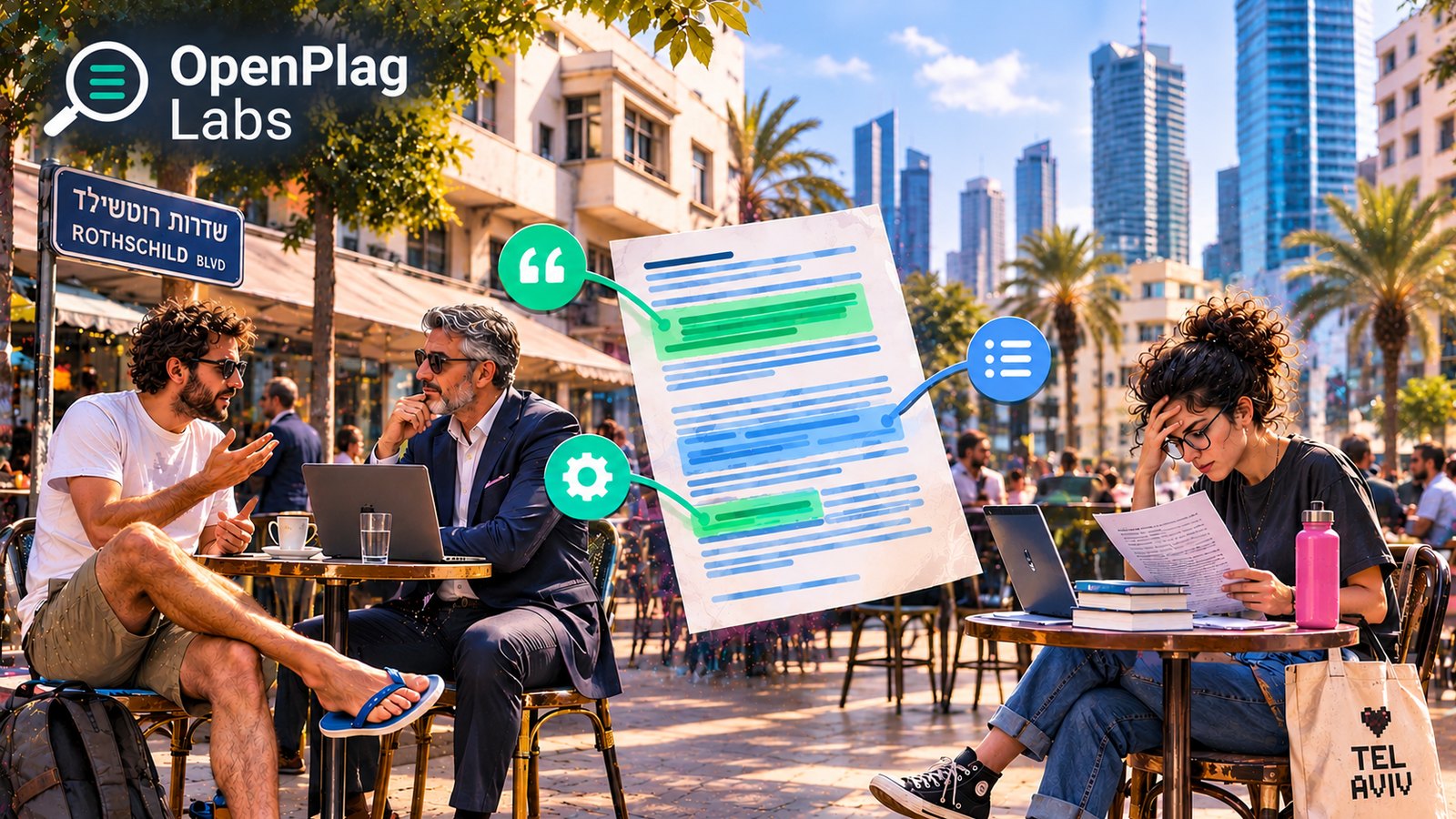
Rothschild Boulevard, ten in the morning. At one table, a founder in flip-flops tells an investor that his system "works on its own, like a real employee." At the next table, a graduate student is rewriting her methodology chapter for the third time, because something in it still does not sit right with her. Only one of them was describing agency.
Prof. Yuval Noah Harari likes to say that AI is not a tool but an agent, because it can make decisions and generate ideas on its own. There is truth in that, but the line mixes up two things: being an agent, and having agency.
An agent is a system that receives a goal and acts to achieve it, and in that sense AI is certainly an agent. But choosing a course of action and sticking to it is nothing new. An enemy character in a computer game decides whether to attack or retreat based on the state of play, and nobody thinks it has a will. Every IF in a piece of code, every AND and OR, every loop that decides whether to keep going, is a choice. AI chooses in far more sophisticated ways, but still within a goal someone else set. When the task ends, so does the activity.
Agency is something else: the ability to generate the goal yourself and hold on to it when nobody is asking. A researcher does not wait to be asked. He runs into a finding that does not add up and will not let it go, sometimes for years and without anyone commissioning the work. True, human motivation also came from somewhere, from evolution or upbringing. But in a person it becomes his own, while in the machine it stays borrowed.
Which brings us to responsibility. AI can work at a high, up-to-date level, but it follows the logic of the prompt it received at that moment. It does not ask why this method and not another, how a particular wording in the methodology chapter will shape what can be argued later, or whether a result actually serves the argument. The researcher asks that, and phrases his prompts and shapes the output accordingly. The paper is the expression of his agency, and AI is one of the tools along the way. Nobody blames the calculator for a flawed statistical analysis, and nobody gives it credit for a good one either.
So AI can help at every stage. The question, the choice and the responsibility stay with the researcher.
What do you think?